1 - Bookkeeping for Real Estate Investors
Bookkeeping for Real Estate Investors:
The Complete Strategy Guide
By Michael Glaspie | The Real Estate CFO | G2 Business Solutions
Most real estate investors are good at finding deals. They know their markets, they can spot undervalued properties, and they work hard. But ask them where their money went last month, and you'll get a blank stare.
That's the gap bookkeeping for real estate investors closes. It's not glamorous. It won't go viral on social media. But done right, it is the single most important financial habit you can build — because you cannot manage what you cannot measure.
In this guide, I'm going to walk you through exactly how to set up a bookkeeping system for your real estate portfolio, what tools to use, common mistakes to avoid, and how clean books can literally save you thousands at tax time
1. Why Bookkeeping Is Your Financial GPS
Think about driving at night with no headlights. You might know where you're going, but you can't see what's right in front of you. That's what running a real estate business without bookkeeping looks like.
Your books are your financial GPS. They tell you:
•How much money came in and where it came from
•How much went out and what it was spent on
•Which properties are performing and which are dragging you down
•What your actual profit margin looks like (not the number in your head)
•Where you stand heading into tax season
Without this data, you're making six and seven-figure decisions based on gut feelings. Some investors get lucky. Most don't.
2. The #1 Mistake Real Estate Investors Make With Money
Mixing personal and business finances.
This is the single most common mistake I see from new and even experienced real estate investors. They run everything through one bank account — personal bills, rental income, maintenance costs, and dinner out on Friday night all in the same place.
The problems this creates:
•You can't accurately track income per property
•Tax deductions get missed because expenses are buried in personal spending
•You have zero asset protection — your personal assets are at risk if you're sued
•A CPA cannot help you effectively if your books are a mess
•You have no idea if your real estate business is actually profitable

3. Step-by-Step: How to Set Up Your Real Estate Bookkeeping System
Setting up a bookkeeping system doesn't have to be complicated. Here's the process I walk every client through:
Step 1: Separate Your Business and Personal Finances
Open dedicated bank accounts for each entity or LLC. Get a business credit card for business expenses only. Never co-mingle personal and business funds again.
Step 2: Choose Your Bookkeeping Software
QuickBooks Online is the industry standard for real estate investors. It integrates with your bank, tracks income and expenses by property, and makes tax prep significantly easier. More on software options in Section 4.
Step 3: Set Up Your Chart of Accounts
A Chart of Accounts is simply a list of categories for your income and expenses. For real estate investors, this should include categories like: Rental Income, Repair & Maintenance, Property Management Fees, Mortgage Interest, Insurance, Depreciation, and Professional Services.
Step 4: Connect Your Bank Accounts
Link your business bank accounts and credit cards to your bookkeeping software. Transactions will import automatically — you just need to categorize them correctly.
Step 5: Do a Monthly Reconciliation
Every month, compare your bookkeeping records to your actual bank statements. This catches errors, duplicate entries, and ensures your records are accurate. It takes 30 minutes a month and saves you hours at tax time.
Step 6: Track Income and Expenses by Property
This is where most investors fall short. You need to know not just your total income and expenses — but how each individual property is performing. Use classes or jobs in QuickBooks to tag each transaction to a specific property.
4. The Right Tools for Real Estate Bookkeeping
The best bookkeeping tool is the one you'll actually use. That said, here are the most common options and my take on each:
QuickBooks Online⭐ Best Overall
The gold standard for real estate investors who are serious about their finances. Robust reporting, property-level tracking, bank integration, and widely supported by CPAs and bookkeepers.
Stessa⭐ Best Free Option
Built specifically for rental property investors. Great for beginners and investors with smaller portfolios. Limited functionality compared to QuickBooks but free and easy to use.
Wave Accounting Good for Beginners
Free software with basic income and expense tracking. Fine for getting started but lacks the depth needed as your portfolio grows.
Spreadsheets (Excel/Google Sheets) Not Recommended for Scaling
Many investors start here. It works until it doesn't — manual entry is error-prone, there's no bank integration, and reporting is limited. Upgrade when you're ready to get serious.
5. Understanding Your Key Financial Statements
You don't need to be an accountant, but you do need to understand three core reports. These are the financial pulse of your real estate business.
The Profit & Loss Statement (P&L)
Shows your total income minus total expenses over a period of time. Run this monthly. It tells you whether your portfolio is actually making money — not just generating revenue.
The Balance Sheet
A snapshot of what you own (assets), what you owe (liabilities), and your net worth (equity) at a specific point in time. This is what lenders look at. This is what tells you if you're actually building wealth.
The Cash Flow Statement
Tracks actual cash moving in and out of your business. You can be profitable on paper and still run out of cash. This report prevents that from sneaking up on you.
6. Tax Deductions You'll Miss Without Good Books
This is where bookkeeping stops being a chore and starts being a moneymaker. When your books are clean, your CPA can find every legitimate deduction available to you as a real estate investor.
Here are the major ones:
•Mortgage interest on investment properties
•Depreciation (one of the most powerful tools in real estate — your property loses value on paper so you save real money on taxes
•Property management fees
•Repairs and maintenance costs
•Insurance premiums
•Professional services (CPA, attorney, bookkeeper, CFO fees)
•Travel expenses related to your properties
•Home office deduction (if you manage your portfolio from home)
•Marketing and advertising costs
•Utilities paid by the landlord

7. Bookkeeper vs. CPA: Who Does What?
This is one of the most misunderstood distinctions in real estate. These are not the same role, and confusing them is costing investors money.
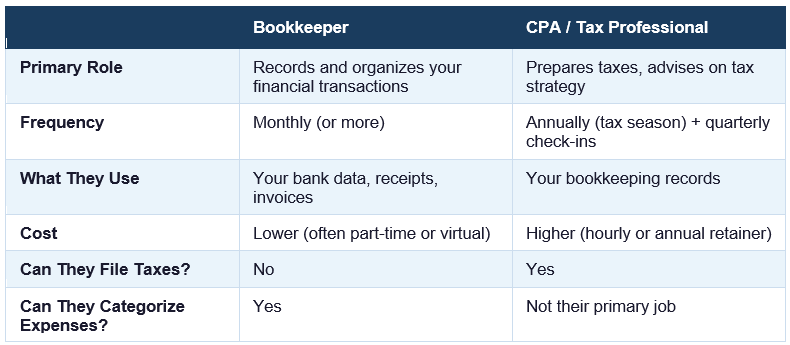
Both roles are essential. And critically — they need to communicate with each other. A CPA working off disorganized or incomplete books cannot serve you at the highest level.
8. How Often Should You Update Your Books?
Here's a simple schedule that works for most real estate investors:
Weekly
Review and categorize new transactions in your bookkeeping software. Takes 15–20 minutes if you stay consistent.
Monthly
Reconcile your books against your bank statements. Run your P&L report. Review cash flow per property.
Quarterly
Meet with your bookkeeper (or review on your own) to look at trends. Are any properties underperforming? Are expenses creeping up? Do you need to adjust rent?
Annually
Year-end close. Get your books finalized before handing them to your CPA. This should be clean and ready to go — not a scramble.
9. Frequently Asked Questions
Q: Do I need a separate bookkeeping system for each rental property?
A: Not necessarily a separate system, but you do need to track income and expenses per property. In QuickBooks, you can do this using the Class or Location tracking feature. One software, organized by property.
Q: How much does a real estate bookkeeper cost?
A: A part-time or virtual bookkeeper for a small-to-mid portfolio typically runs $200–$600/month. For larger portfolios or full-service options, costs go up. It's one of the highest-ROI hires a real estate investor can make.
Q: Can I do my own bookkeeping?
A: Yes — especially when you're starting out with one or two properties. As your portfolio grows, your time is better spent on acquisitions and operations. That's when outsourcing bookkeeping makes sense.
Q: What's the difference between cash and accrual accounting for rental properties?
A: Cash accounting records income when you receive it and expenses when you pay them. Accrual accounting records them when they're earned or incurred, regardless of payment. Most small real estate investors use cash basis accounting — it's simpler and usually acceptable for tax purposes.
Q: Will good bookkeeping actually help me pay less in taxes?
A: Absolutely. Clean, well-categorized books ensure your CPA can find every deduction you're entitled to. Depreciation, repairs, professional fees, interest — all of these require documentation. Without it, they get missed.
10. Final Thoughts: Clean Books = More Wealth
Bookkeeping isn't just an accounting task. It's a wealth-building tool.
Every dollar you can track is a dollar you can manage. Every expense you can document is a potential deduction. Every property you can analyze individually is a decision you can make with confidence — not guesswork.
Real estate investors who take their finances seriously build portfolios that last. The ones who don't? They stay busy without building real wealth.
Start with one step. Open a separate business account. Download QuickBooks. Call a bookkeeper. Whatever it is for you — start this week.

About the Author
Michael Glaspie is a former U.S. Army Green Beret, real estate investor (134+ rental units), and Fractional CFO to real estate investors nationwide through G2 Business Solutions. He helps investors increase profits, reduce taxes, and build wealth through strategic financial management.
YouTube: @themichaelglaspie | Instagram: @michael.s.glaspie | G2BusinessSolutions.com