
The 10 Biggest Financial Mistakes Real Estate Investors Make — And How to Fix Them
The 10 Biggest Financial Mistakes Real Estate Investors Make — And How to Fix Them
Michael Glaspie | The Real Estate CFO | G2 Business Solutions
Real estate is one of the most powerful wealth-building vehicles available. It's also one of the most unforgiving for investors who don't manage the financial side seriously.
After working with real estate investors as a Fractional CFO — and building my own portfolio of 134+ rental units — I've seen the same financial mistakes made over and over again. They're predictable, they're preventable, and left unchecked, they can stall or even unravel an otherwise promising portfolio.
Here are the 10 most common financial mistakes I see — and exactly how to fix each one.
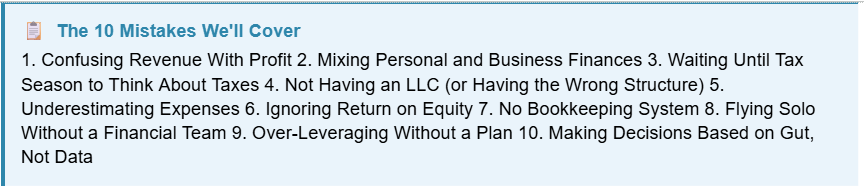
Mistake #1: Confusing Revenue With Profit
This is the most fundamental financial mistake in real estate — and it's shockingly common. Investors celebrate bringing in $20,000/month in rent without looking hard at what's actually left after expenses.
Mortgage payments, property taxes, insurance, management fees, maintenance, vacancies, capital expenditures — these can consume $16,000–$18,000 of that $20,000 easily. Your actual profit is a very different number from your revenue.
The Fix:
Run a Profit & Loss statement monthly for your portfolio. Know your gross revenue, your total expenses by category, and your net income. These are different numbers. Treat them that way.
Mistake #2: Mixing Personal and Business Finances
Running personal and business transactions through the same bank account is one of the most damaging habits a real estate investor can have. It makes bookkeeping a nightmare, destroys your asset protection, and makes it nearly impossible for your CPA to find every available deduction.
The Fix:
Open a dedicated business bank account for each entity you operate. No exceptions. Every business expense goes through the business account. Every rental income deposit lands there first. This one change has an outsized impact on your financial clarity and tax outcomes.
Mistake #3: Waiting Until Tax Season to Think About Taxes
Tax strategy is not a once-a-year conversation. It's a year-round discipline. By the time your CPA is preparing your return, the decisions that determine your tax bill have already been made.
The investor who plans in January — reviewing depreciation strategy, capital improvement timing, entity elections, and estimated payments — will pay dramatically less than the one who shows up in March hoping for good news.
The Fix:
Schedule four meetings a year with your CPA. Q1 for tax filing and planning. Q2 for mid-year check-in. Q3 for year-end projection and adjustments. Q4 for year-end moves before December 31st.

Mistake #4: Not Having an LLC (or Having the Wrong Structure)
Owning investment properties in your personal name exposes your personal assets — your home, savings, vehicles — to liability from tenant lawsuits, accidents, or other property-related claims. An LLC is your legal shield.
The flip side: some investors form LLCs without understanding the structure. An LLC with no operating agreement, commingled funds, and informal management provides almost no real protection. Courts can 'pierce the corporate veil' if the entity isn't maintained properly.
The Fix:
Work with a real estate attorney to form the right entity structure for your portfolio. Maintain the LLC properly: separate bank accounts, documented meetings (if required by your state), and no commingling of funds. Revisit your structure as your portfolio grows.
Mistake #5: Underestimating Expenses
Most rental property deals are underwritten with optimistic expense assumptions. Vacancy rates of 0%, maintenance budgets of $0, and property management savings because 'I'll manage it myself' are the three most common culprits.
Real expenses for a rental property typically include:
• Vacancy: 5–10% of gross rents
• Maintenance and repairs: 1% of property value annually
• Property management: 8–12% of collected rents (even if self-managing now — time has a cost)
• Capital expenditures reserve: 5–10% of gross rents for roof, HVAC, appliances
• Insurance, taxes, and any HOA fees
The Fix:
Use conservative expense assumptions in every underwriting model. If the deal doesn't work with realistic expenses, it doesn't work. Period.
Mistake #6: Ignoring Return on Equity
As properties appreciate, equity builds up. Most investors just let it sit. But equity is capital — and idle capital has an opportunity cost. A property with $300,000 in equity generating $12,000/year in cash flow has a 4% ROE. That may be well below what you could earn by redeploying that equity.
The Fix:
Calculate ROE annually for every property. (Annual Cash Flow ÷ Current Equity = ROE.) Properties with low ROE are candidates for refinancing, exchanging, or selling. Make your equity work.
Mistake #7: No Bookkeeping System
Running a real estate portfolio without a bookkeeping system is like running a restaurant without a cash register. You might be profitable, but you have no idea — and you definitely can't prove it to a lender, a partner, or the IRS.
The Fix:
Set up QuickBooks Online (or at minimum, Stessa for smaller portfolios). Connect your business bank accounts. Categorize transactions weekly. Reconcile monthly. Run a P&L every month. This is the minimum viable financial infrastructure for a real estate portfolio.
Mistake #8: Flying Solo Without a Financial Team
Real estate investors who handle everything themselves — bookkeeping, tax prep, legal structure, financial strategy — are almost always doing all of it poorly. Not because they're not smart. Because expertise is deep and no one person can be excellent at all of it.
The Fix:
Build your financial team: a bookkeeper, a real estate CPA, a real estate attorney, and eventually a Fractional CFO for strategic oversight. These aren't expenses — they're investments that pay for themselves many times over through tax savings, legal protection, and better financial decisions.
Mistake #9: Over-Leveraging Without a Plan
Leverage amplifies returns — but it amplifies losses too. Investors who aggressively pull equity and take on debt in a rising market often find themselves dangerously exposed when conditions shift. High debt service with thin cash flow margins leaves no room for vacancies, repairs, or rate adjustments.
The Fix:
Know your debt service coverage ratio (DSCR) for every property and your portfolio overall. Maintain adequate cash reserves. Don't pull equity without a clear, underwritten deployment plan. Growth is good; over-leveraged growth is fragile.
Mistake #10: Making Decisions Based on Gut, Not Data
Real estate investing rewards patience, analysis, and discipline. It punishes emotional decisions — buying the property you love, holding assets that aren't performing, and avoiding the hard financial conversations.
The Fix:
Create a decision framework. Before any major financial move — acquisition, refinance, sale, 1031 exchange — run the numbers. Build a model. Get input from your financial team. Gut instinct is a starting point, not a strategy.

Frequently Asked Questions
Q: What's the first financial mistake I should fix if I can only tackle one?
A: Separate your finances. Open a business bank account for every entity and stop mixing personal and business money. Everything else in this list gets easier once your money is organized correctly.
Q: How do I know if my real estate business is financially healthy?
A: Run a monthly Profit & Loss statement, know your cash flow per property, and review your balance sheet quarterly. If you can answer — with data — how much you made last month and which property is your best and worst performer, you're on the right track.
Q: When should I start worrying about these things?
A: Before you buy your first property. The habits and systems you build early determine how easily you'll scale. It's much harder to clean up years of financial mess than to start clean.
Final Thoughts
None of these mistakes are fatal on their own. Most investors make several of them, especially early in their journey. The ones who build lasting wealth are the ones who identify the gaps, fix them systematically, and build financial discipline into their business.
Your real estate portfolio is a business. Treat it like one.
Clean books. Smart tax strategy. The right team. And decisions made with data, not guesses. That's the formula.

About the Author
Michael Glaspie is a former U.S. Army Green Beret, real estate investor (134+ rental units), and Fractional CFO to real estate investors nationwide through G2 Business Solutions. He helps investors increase profits, reduce taxes, and build wealth through strategic financial management.
YouTube: @themichaelglaspie | Instagram: @michael.s.glaspie | G2BusinessSolutions.com